Voice AI Just Doubled. Here's the Math That Changed My Mind.

I read the ElevenLabs valuation jump as another overheated AI headline. Then I checked the numbers myself.
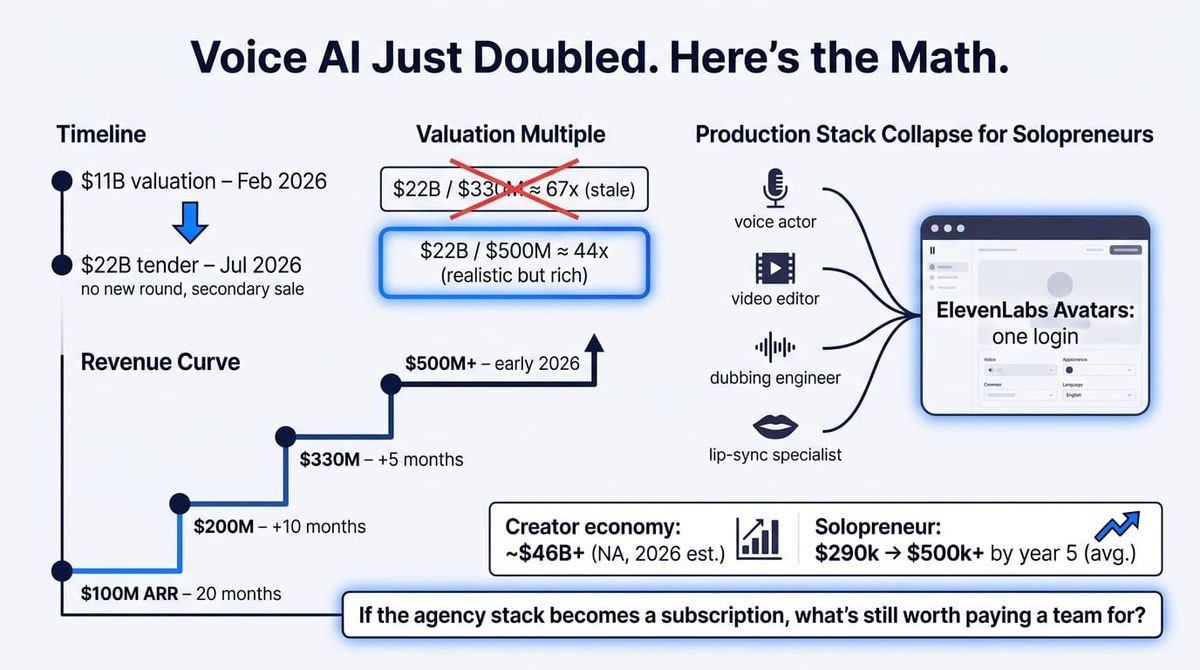
Bloomberg reported on July 2 that ElevenLabs is in early talks for an employee tender offer that would value the voice AI company at roughly $22 billion, expected to close by September. That's double the $11 billion mark it hit in February, when it closed a $500 million Series D. Five months, same company, twice the price tag, and no new funding round in between. Just existing shares changing hands at a higher price.
My first reaction was skepticism. I've read enough AI valuation headlines this year to have a reflexive response: momentum dressed up as fundamentals, one hot secondary sale used to mark an entire company. I nearly filed this one under "frothy" and moved on to the next story in the queue.
The Reality: Two Different ARR Snapshots
Before writing it off, I checked the actual revenue behind the multiple. ElevenLabs closed 2025 at more than $330 million in annual recurring revenue, a trajectory CEO Mati Staniszewski laid out in blunt terms: $100 million in ARR after 20 months, $200 million ten months after that, $330 million five months after that. Each stretch shorter than the one before it.
Run $22 billion against that $330 million figure and the multiple lands around 67x. Aggressive, but not unheard of for infrastructure the market has decided is category-defining. The catch: $330 million is where 2025 ended, and reporting tied to the tender offer puts ElevenLabs' ARR crossing $500 million within the first four months of 2026. Those are two different points on the same curve, five months apart, not one wrong number. Rerun the math against the more current figure and the multiple drops closer to 44x. Still rich. Not the fantasy number a single headline figure implies.
That's the part I'd underweighted, and it was about which number, not a wrong one. The valuation isn't chasing the story. The growth curve underneath it is arguably still catching up.
The Product Move Underneath the Number
The financing headline is the part that travels furthest. The product move is the part that matters more to anyone building alone.
Two things shipped around the same window as the valuation news. The client SDK now exports a function that lets a live voice conversation with an AI agent take in images and other content mid-session, not just text and audio. And ElevenLabs introduced Avatars in ElevenCreative, which combines its speech models and lip-syncing models in one workflow: upload a photo, write a script, pick a voice, and generate a talking-head video with the voice and the lip movement produced together instead of stitched from separate tools after the fact.
Neither of those is a smarter model underneath. Both are the production stack collapsing. Voice actor, video editor, dubbing engineer, lip-sync specialist: that used to be four line items and four handoffs. It's now one login.
What This Actually Buys Someone Working Alone
Here's where the valuation number and the product number meet. Market researchers put the North America creator economy somewhere in the tens of billions for 2026, with estimates ranging as high as $46 billion depending on methodology; the exact figure moves depending on who's counting, but the direction holds across every firm tracking it. Solopreneur revenue surveys point the same way, and should be read the same way, as directional rather than a guarantee for any one business: the Gusto Solopreneurship Report, one of the more cited surveys in the space, puts average first-year solopreneur revenue above $290,000, climbing past $500,000 by year five, roughly 25% ahead of a similarly skilled employee at that point.
Those numbers only hold up if the cost of producing professional-grade output keeps falling for the person operating without a team behind them. That's exactly what a platform tripling its ARR in fourteen months and doubling its valuation on the back of it is signaling, whether ElevenLabs intended the signal or not.
I haven't touched Avatars yet. I don't have a verdict on the output quality, and I'm not going to pretend I do. But the math told me something the headline didn't. This isn't hype outrunning fundamentals. It's fundamentals that happen to compress the same production stack a one-person business has to pay for out of pocket.
The Question I'm Actually Sitting With
I've spent more than two decades inside large public-sector organizations, watching how long an institutional budget cycle takes to catch up to what a subscription can already do. That gap used to be the entire story: what an enterprise could afford versus what one person could not.
Voice AI's valuation doubling in five months isn't really a story about ElevenLabs. It's a data point in a much bigger one: the gap between what a company pays a production team and what a single, AI-leveraged operator can now output on their own is closing faster than most solopreneur playbooks have caught up to.
If the stack that used to require an agency now costs a subscription, what's actually still worth paying a team for?