The Government Is Now Inside the Distribution Loop

Since frontier AI became commercially available via API — roughly 2022 onward — the assumption inside large organizations was simple: sign a contract, get access. Government was somewhere downstream, writing policy, setting export rules, reacting to what labs shipped.
On June 12, 2026, that assumption cracked.
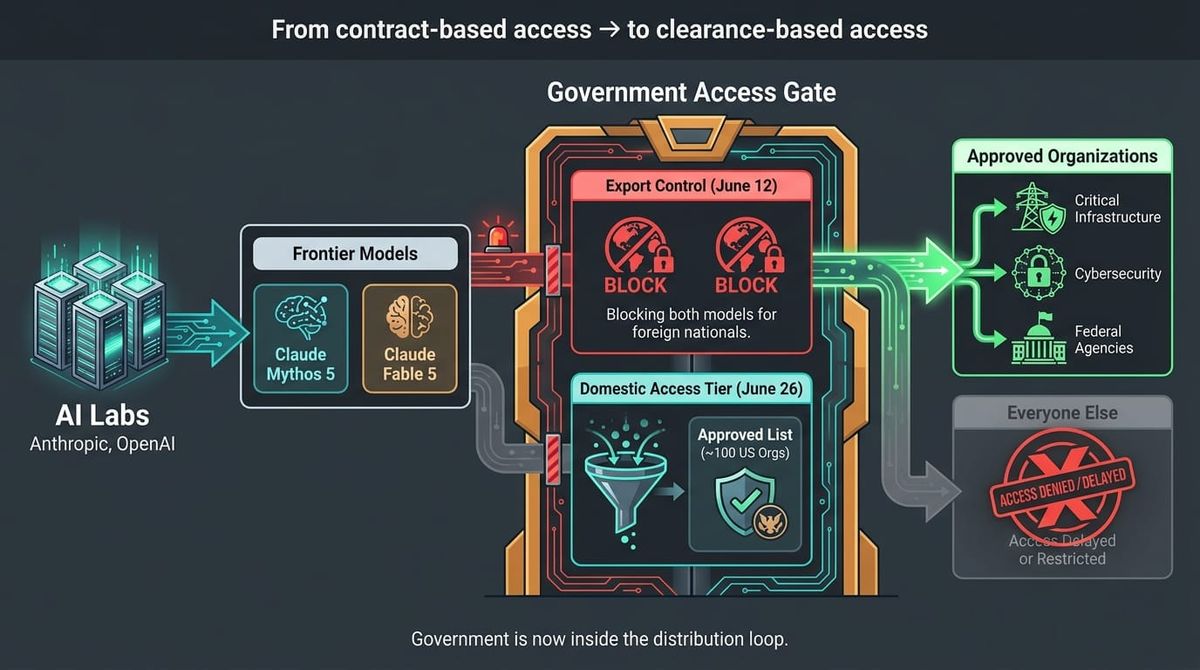
The US government issued an export control directive ordering Anthropic to immediately disable Claude Fable 5 and Claude Mythos 5 — two of the most capable AI models available — for every foreign national, including Anthropic's own non-US employees. The trigger: a potential method of bypassing safeguards designed to limit the models' use for identifying software vulnerabilities. One security concern, and two frontier AI systems went dark globally.
That part is recognizable. Export control has a long institutional history.
What happened fourteen days later is not.
On June 26, Commerce Secretary Howard Lutnick cleared Claude Mythos 5 for a list of roughly 100 trusted US organizations — Fortune 500 companies, cybersecurity firms, operators of critical infrastructure, and federal agencies, many of them participants in Anthropic's Project Glasswing initiative. The same day, OpenAI previewed GPT-5.6 Sol to approximately 20 government-approved partners. Two labs. One day. Same mechanism.
Claude Fable 5 is still offline.
What Most Coverage Is Missing
The June 12 directive was export control — a border mechanism. It blocked foreign nationals. It is the kind of government intervention that defense contractors and regulated industries have navigated for decades.
The June 26 reinstatement is different in kind.
It did not lift the restriction uniformly. It created a list. US customers of US companies now need to be on a government-curated approved list to access frontier capabilities that their commercial relationship alone does not unlock.
That is not a border mechanism. That is a domestic access tier — sitting between the model and the market, operating inside the United States, applying to American organizations buying from American labs.
Government is no longer downstream of AI distribution. It is inside the release cycle.
One Model Back. One Still Dark.
The second signal is harder to read but more important.
Claude Fable 5 and Claude Mythos 5 came from the same lab. They went offline on the same day for the same stated reason. Only one has been restored. The divergence is not company-specific — it is capability-specific. The criteria being applied are not about Anthropic as a vendor. They are about what each model can do at a given capability tier.
This matters for how organizations think about procurement. And about competitive positioning.
The 100 organizations on the Mythos 5 approved list have a real advantage. In cybersecurity, critical infrastructure, and defense-adjacent work, the most capable frontier models matter operationally. Those organizations can use them. Organizations not on the list cannot — at least not today.
But the leapfrog thesis has a ceiling. This restriction is likely time-limited. Fable 5 reinstatement looks close. When the full restrictions lift, the access gap closes for most commercial applications.
What does not close is the institutional gap.
The Gap No Procurement Process Was Built For
After 20 years watching large organizations navigate the relationship between technology capability and regulatory constraint, the pattern is consistent: governance frameworks follow the rules, not the other way around. Organizations build the compliance function after the requirement hardens. They add the review step after the incident. The framework eventually catches up.
Today's enterprise AI procurement process was designed for a world where access follows the contract. Evaluate vendors. Legal reviews the terms. Security reviews the architecture. IT approves the integration. At the end of that process, you have access.
None of that process was built to track whether a specific capability tier is currently cleared for your organization. None of it surfaces when a model goes offline, why it went offline, or what reinstatement requires. None of it answers the question that is now operationally relevant: Is this organization on the approved list for this model, right now?
The competitive advantage the approved organizations have today is not only access to Mythos 5. It is the institutional knowledge they are building while they use it — the governance function that learns to track access status across capability tiers, the relationships that maintain organizational standing with whatever approval bodies are emerging, the procurement framework that treats access variability as a business risk, not an anomaly.
That knowledge persists long after the specific restriction lifts.
The organizations that win in an access-tiered AI environment will not be the ones that react fastest when a model goes dark. They will be the ones that built the infrastructure before they needed it.
The question has shifted.
It is no longer "can we afford access?"
It is "are we cleared for it — and do we have the machinery to stay that way?"