When Institutional Capital Bets on One Person

I failed at solopreneurship once.
Not the "learned some hard lessons" kind of failed. The quiet kind, where you shut it down and go back to full-time work and don't talk about it much.
So when I saw that Workday, Anthropic, and LISC just launched an accelerator putting real seed funding behind fifteen solo founders, my reaction was complicated. Part validation, part "where was this five years ago."
Here's what's actually in the program, and why I think it matters more than the funding number suggests.
The Announcement
Workday, Anthropic, and LISC (the community development nonprofit) launched an AI-focused Solopreneurship Accelerator in May 2026.
Fifteen founders, selected through LISC's business development network rather than open application. Each gets a $10,000 grant from the Workday Foundation, for $150,000 total.
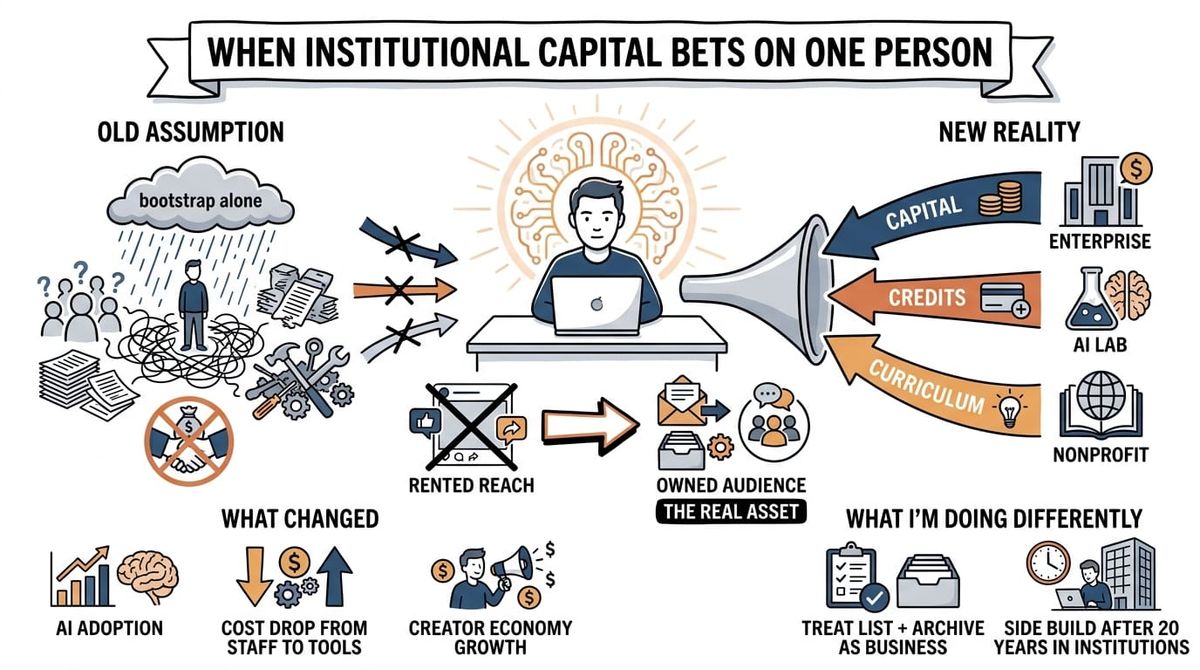
Add free Claude AI credits from Anthropic. A curriculum covering strategy, marketing, fulfillment, CRM, and financial management. Coaching through LISC's business development organizations.
The inaugural cohort starts this month. LISC also plans to publish the curriculum itself, so the actual syllabus becomes public homework for anyone paying attention, invited cohort or not.
What I Assumed Going In
I assumed, back when I was building on my own, that solopreneurship was a bootstrap game by definition.
You cobbled together tools, taught yourself marketing badly, absorbed every mistake alone, and hoped it compounded before you ran out of runway or patience.
If a large company or a foundation was ever going to put real money behind someone building alone, I figured it would be a gesture. A photo op. Not infrastructure.
What Actually Changed
That assumption held right up until this year.
A Fortune 500 enterprise software company, a frontier AI lab, and a community development nonprofit just agreed, with actual capital, that a business run by one person augmented by AI is a fundable category now. Not a fringe bet.
The number behind that bet is bigger than the accelerator itself.
Seventy-eight percent of solopreneurs expect AI to materially change how they operate this year.
A full solo tech stack, the CRM, the content tools, the automation, the analytics, now runs $3,000 to $12,000 a year. A 95 to 98 percent reduction against what the same functions used to cost in staff.
The creator economy is tracking toward $480 to $500 billion by 2027, with more than 50 million people in it.
The Real Shift
Here's the part I think matters more than the funding: the structural shift everyone in this space keeps naming is the move from rented reach to owned audience.
A platform algorithm decides who sees your work today. Your list, your archive, your community, decide who sees it in five years.
Rented reach resets every time a platform changes its feed. Owned audience is the one asset in this model that compounds instead.
The Piece I Got Wrong
That's the piece I got wrong the first time.
My instinct that tools were getting cheaper was right. I didn't understand that cheap tools without an owned channel just means producing more content into somebody else's feed, at somebody else's mercy.
The tools removed the friction. They didn't remove the need for a domain expert with judgment, and they didn't build an audience for me.
I still had to do that myself, and I hadn't.
What I Don't Know
I don't have Sam Altman's or Naval Ravikant's confidence about what any of this means once the frontier labs get where they're trying to go.
Nobody actually knows what the economy looks like on the other side of general intelligence, if that's what arrives. Every prediction about it, including the confident ones, is a guess wearing the costume of an inevitability.
What I know is smaller and more useful to me directly: institutional capital no longer treats "one person, AI-augmented, no employees" as a hobby. That fact holds regardless of how the bigger story resolves.
What I'm Doing Differently
So here's what I'm doing differently this time.
After two decades inside large public-sector organizations watching well-funded initiatives stall on the same predictable friction points, I'm now trying to build something of my own on the side.
I'm treating my own list and my own archive as the actual business, not a platform's feed. LinkedIn, this blog, whatever comes next, are distribution. The thing that compounds is what I own.
I don't know if I'll get this attempt right either.
But I've stopped guessing about whether solopreneurship at AI scale is a real category. Three institutions with three different incentives just put money behind the same bet, in public, with their names on it.
That's worth paying attention to, especially if your last attempt at this ended quietly too, and you assumed the failure was about you rather than about the moment.
What would you build differently if you believed, the way these three institutions apparently do, that this is infrastructure now, not a hobby?