Tesla Subsidized Grok. Its Engineers Chose Claude Anyway.

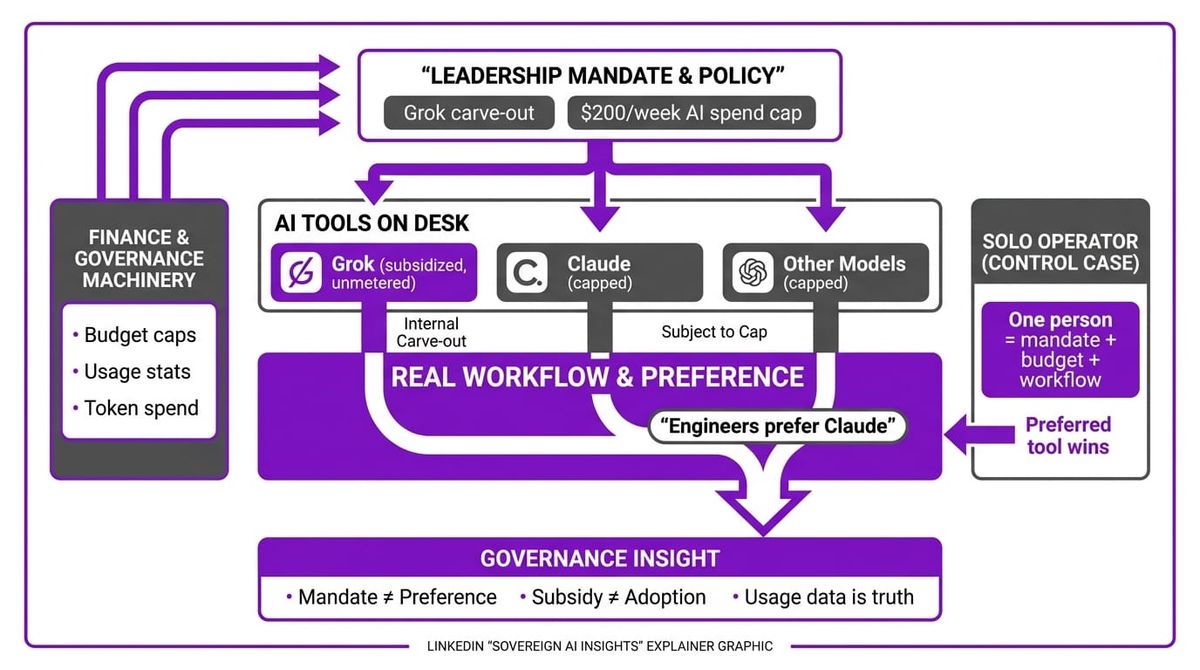
I assumed that when a founder owns both the AI lab and the company deploying it, adoption is a formality. A policy change at Tesla this month proved the opposite.
Starting July 6, Tesla capped employee AI tool spending at $200 a week. The cap applies to Anthropic, OpenAI, and Google. It does not apply to xAI, the AI company Musk also runs and the one Tesla has put $2 billion into. Software engineers had reportedly been burning through thousands of dollars in tokens a week, and the company needed a lever. It picked one that happens to make Grok the only unmetered option on the desk.
Here's the part that should have been predictable and wasn't. According to four people familiar with internal usage patterns, cited by Electrek, Tesla engineers largely prefer Claude over Grok, cap or no cap. The tool that costs them nothing lost to the tool they'd rather pay for.
The point isn't that Grok is uncompetitive. Musk announced on X that Grok 4.5, built on a 1.5-trillion-parameter V9 foundation model with Cursor's developer-workflow data folded in during supplemental training, entered private beta at SpaceX and Tesla in late June.
His own read on the early evals: performance close to, maybe past, Claude Opus. Nobody outside xAI has seen an independent benchmark, so treat that claim as marketing until proven otherwise. But the parameter count is real and the compute behind it is real. This is a frontier-scale effort, not a rounding error, going up against the incumbent and losing the room anyway.
I don't have a personal scar from deploying AI inside a large organization. My work doesn't run AI systems day to day. It runs procurement gates, security reviews, and budget cycles, the machinery that decides whether any new technology actually ships regardless of what leadership mandates. That machinery is exactly what makes Tesla's memo interesting to me, not as an AI story but as a governance one.
The honest questions I keep circling are the ones that machinery would ask of a carve-out like Grok's before it ever reached someone's desk. How does this hold up in a government agency, where a security review can sit for months after the rollout decision was already made in a meeting nobody minuted? How does it hold up in a private company with none of that friction? If a mandate like this landed where I sit, what breaks first, and what actually survives contact with the sign-off chain?
Ask for the Usage Statistics
I kept coming back to something Michael Gray, CTO of Thrive, said on a recent podcast about enterprise AI rollouts. His advice to anyone who tells you their organization is all-in on AI: ask for the usage statistics. Not the subscription count. Not the roadmap. The actual login and token numbers, broken down person by person. Because the tools that get announced and the tools that get used are two different lists, and the gap between them is where every AI budget quietly leaks.
Tesla just ran that test at company scale, with real money attached, and the usage numbers came back speaking for themselves. The mandate said Grok. The workflow said Claude.
The Control Case
The same test runs with nobody enforcing it. A company of one has no CFO issuing a $200 cap and no CTO carving out an exception for a favored vendor. The mandate, the budget, and the workflow all sit inside one person, so the gap between what you're told to use and what you actually reach for collapses to zero.
This is the control case. Tesla proved mandate and subsidy can't force preference even when both are stacked in the mandate's favor. A solo operator, with none of that machinery in place at all, proves the same thing from the other direction: preference doesn't need permission to win. It just needs friction to lose.
What a Policy Can't Buy
Tesla isn't alone in reaching for the expense report as a governance tool. Uber capped employee AI spending at $1,500 a month after blowing through its 2026 budget by April. Meta, Amazon, and Walmart are pushing similar caps or steering staff toward cheaper models. Token-based billing has made every prompt a line item, and finance departments are noticing. That part of the story will keep spreading, all the way down to the mom-and-pop shop deciding whether a $20-a-month seat belongs on the company card.
What won't spread as easily is the illusion that a policy can manufacture a preference. You can subsidize a tool. You can mandate a tool. You cannot subsidize your way into someone reaching for it at 11pm when the deadline is real and nobody is watching the expense report.
That's the actual signal buried in Tesla's memo, more interesting than the cap itself. Ownership of the model didn't win the room. The carve-out didn't win the room. What won was whatever got the job done fastest with the least friction, chosen by people who had every financial incentive to choose otherwise. If that's true inside the company that owns the lab, it's worth finding out what's true inside yours. Pull your own usage numbers before someone else does it for you.