The Age of Vertical AI Has Begun

I had a tidy theory about where this AI market was headed. Claude Science broke it in one launch.
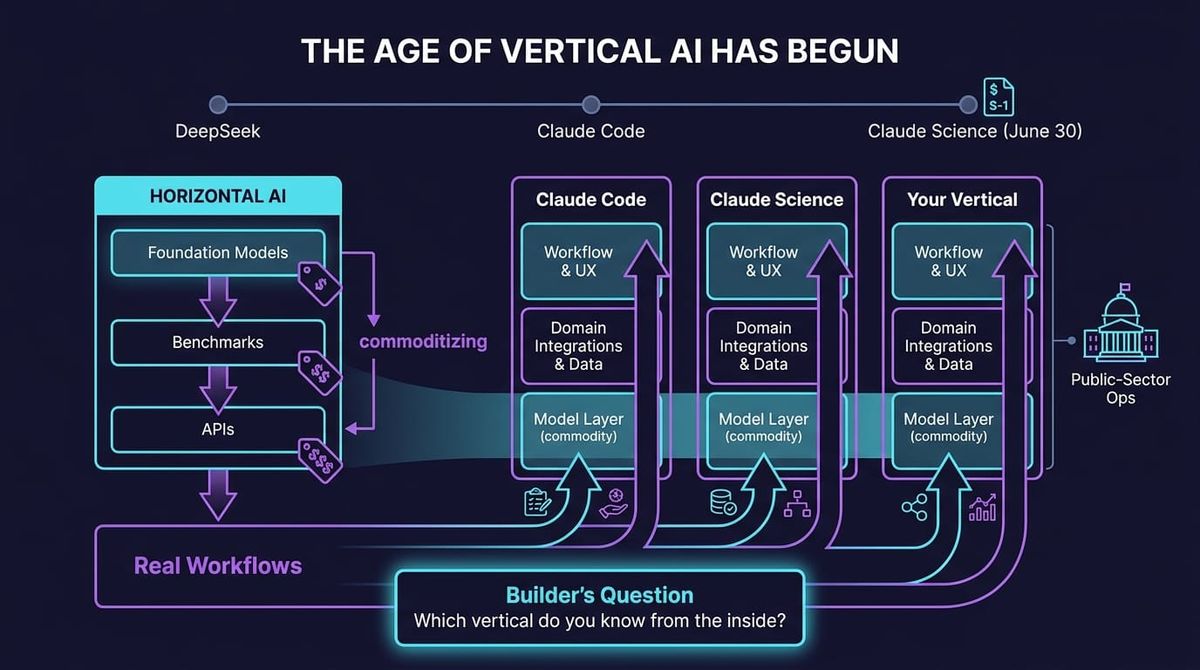
The theory: the model layer is a commodity. DeepSeek was the proof of concept, at least as I read it: a smaller, resourced team closing most of the gap with the frontier, fast and cheap. Every few months another lab does it again. Intelligence was heading toward zero marginal cost, same as compute, same as storage, or so the theory went.
Pick whichever model is cheapest and good enough. Switch when a better one ships. Loyalty to a lab makes about as much sense as loyalty to a specific brand of RAM.
Then, on June 30, Anthropic launched Claude Science.
The Workbench, Not the Model
Claude Science is Anthropic's new workbench for scientists, and it's worth separating the framing from the substance. It isn't a new model. It runs on Anthropic's existing Claude models, wrapped in an integration layer of sixty-plus scientific databases and computation tools. What Anthropic is selling isn't smarter intelligence. It's the workflow wrapped around intelligence that already existed, same operating premise as Claude Code: hand it a high-level instruction, it does the work, in this case literature review, biological data interpretation, multi-step computational workflows, hypothesis generation, and 3D protein structure analysis for drug discovery.
It shipped in beta on July 1 to Pro, Max, Team, and Enterprise subscribers, not a limited research waitlist. Team and Enterprise admins have to switch it on, so "day one" isn't identical to every account everywhere, but it's still a wide first swing for a brand-new product category.
Alongside the launch, Anthropic said it's starting its own pre-clinical drug discovery programs aimed at neglected diseases, the kind traditional pharma doesn't chase because the economics don't work. That's a real, separate commitment. What Anthropic hasn't said is whether those programs run end-to-end inside Claude Science itself, so I won't claim more certainty on that link than the company has given.
The comparison being drawn, by Anthropic and by nearly everyone who covered the launch, is to Claude Code: what that did for software engineering, Claude Science is meant to do for life sciences. I haven't found a verified direct quote establishing that as Dario Amodei's own words, so take it as the framing around the launch, not a quote I'm putting in his mouth.
The Timing I Can't Unsee
Here's the detail that made me sit up, and I want to be upfront that what I do with it next is interpretation, not fact. Anthropic confidentially filed its S-1 on June 1, in the same stretch of weeks as closing a $65 billion round at a $965 billion valuation. Claude Science shipped on June 30.
I read that sequencing as a company building its pre-IPO story on top of a vertical instead of a benchmark. That's my inference, not something Anthropic has said outright, and a reasonable person could read the timing as ordinary product-calendar mechanics that had nothing to do with the S-1 at all.
The Claude Code Playbook
Here's what I'd underweighted. Claude Code didn't win engineers by topping a leaderboard. It won by embedding into the actual workflow, the terminal, the repo, the pull request, until ripping it out cost more than paying for it.
A benchmark lead evaporates in a product cycle. A workflow a research team has built its muscle memory around doesn't.
I've had a version of this thesis sitting in my reading queue for months without fully buying it: Y Combinator has been calling vertical LLM agents the next billion-dollar SaaS opportunity, the workflow wrapped around the model, not the model itself. Claude Science looks like that thesis with Anthropic's balance sheet behind it.
Two data points make a pattern worth testing, not a certainty. But the logic holds. Bundle the model with the workflow, the data integrations, and the institutional buy-in, and you've built something harder to rip out than an API key. If Anthropic, Google, and Microsoft are each racing toward a Claude-for-Law, a Claude-for-Finance, a Claude-for-Engineering, the market isn't consolidating toward one winner. It's splitting into two games. Horizontal, where models get cheaper every quarter. Vertical, where the winner is whoever gets embedded first and deepest.
What's Still Unproven
Sixty-plus integrations is a lot of surface area to keep reliable at scale, and Anthropic hasn't shown it can run all of them cleanly under real research load. Pharma is regulated for good reason. Whether research organizations will accept AI-generated hypotheses inside workflows that eventually feed an FDA submission, without validation overhead that erases the speed advantage, is genuinely open. I don't think anyone outside Anthropic knows the answer yet. Including Anthropic.
Where This Lands for the Builder
"Which model should I use" is becoming close to irrelevant. Models are converging in capability and diverging in price. The question worth losing sleep over: which vertical do you actually know from the inside, well enough to spot where a workflow-embedded AI platform helps, and where it misfires?
I've spent more than two decades inside the operational reality of a large public-sector organization, watching digital transformation land on real budgets, real workforces, real constraints no vendor deck mentions. That's my vertical, chosen or not.
Paul Jarvis wrote the playbook for this in Company of One: build the smallest viable version of the business, run by someone who knows the terrain cold. The plumber with twenty years of field instinct and a 3D printer isn't competing on who owns the best printer. The advisor isn't competing on who has access to the best model. The domain expertise was always the scarce asset. The tools just started showing up capable of matching it.
Here's the diagnostic question worth sitting with: if a Claude-for-your-vertical shipped tomorrow, would it need you, or would it replace the version of you that never got specific enough to be irreplaceable?
I'm still working out my own answer.
What vertical do you actually know well enough to bet on?