Your Next Coworker Doesn't Have an Account. It Is the Account.

I assumed AI assistants were personal.
That was the mental model I carried into every conversation about deploying these tools inside an organization. Each person gets their own session. Their own context. Their own relationship with the tool. The agent lives inside your account, answers your questions, forgets everything when the window closes. Person by person, prompt by prompt.
Anthropic just made that assumption obsolete for Slack-first teams.
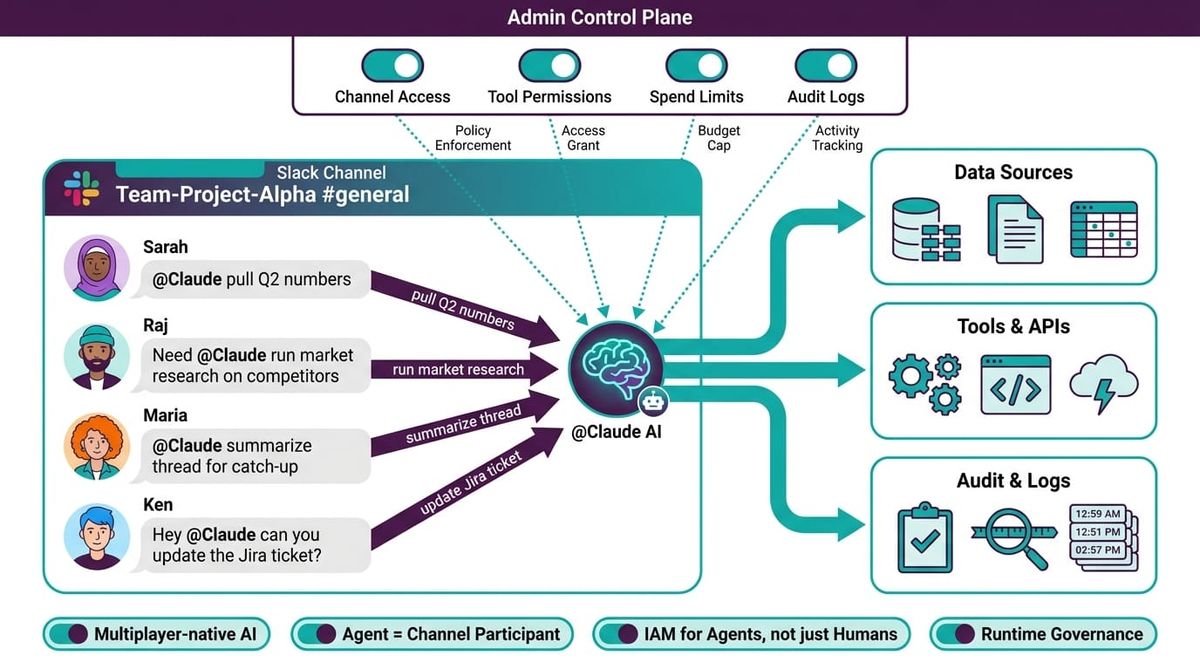
Claude has been available in Slack since 2023. What changed is the architecture. There is one @Claude per channel, shared across everyone in that space. Not your personal integration. Not a per-person session that resets when you close the window. The admin decides which channels Claude joins, which tools it can use, and which data sources it can reach. When someone asks it a question, it answers. When someone else follows up two hours later, it has context from the channels it has been given access to. It is a participant, not a tool you brought to the meeting.
That is a different thing than what I thought I was dealing with.
Here is what it actually changes in practice.
The old model: you go find Claude, you run your prompts, you take the output back to wherever the work is happening. Asynchronous, but only in the direction of "you interrupted your workflow to go use the AI." The agent lived somewhere else.
The new model: the work conversation and the AI occupy the same space. You tag @Claude with "pull the Q2 numbers" or "run market research against these assumptions" (assuming those tools are connected), then go have your next meeting. Claude breaks it into stages, runs it using whatever the admin has set up, and posts the result back in the thread when it's done. Anthropic describes it as capable of scheduling tasks and pursuing a goal over hours or days, not just answering and stopping.
Anthropic says 65% of code produced by their product team now comes from their internal version of this setup. I do not know how to weight that number, but the direction it points is real. When you move an agent from "somewhere you have to go" to "somewhere the work already happens," the calculus on how much you actually use it changes.
I had questions immediately when I understood what this was.
When someone in your team tags @Claude and asks it to pull Q2 sales, where is it pulling from? Is that a live data connector the admin wired up, or is it inferring from what has been shared in conversation? When it runs market research, what does "runs" mean in practice? What is it searching? What is it trusting? These are not rhetorical questions. They are the questions anyone accountable for the output has to be able to answer before the thread goes anywhere.
And the answer depends entirely on how the administrator configured it. The capability is only as grounded as the integration behind it.
That is the part that grabbed me.
Here is where the governance story lives.
Anthropic is explicit about the control plane. Administrators decide which channels Claude can join. They set which tools it can call and which data sources it can access. They define spend limits. They can review activity logs that capture what Claude did and who requested it. That is not boilerplate permission management. It is policy-as-code shipping as a product default, scoped to the channel level. What Claude does in your workspace is a direct function of what your organization explicitly gave it.
This is a familiar problem wearing a new mask. Every large technology deployment I have been involved in eventually surfaces the same core tension: the tool can do more than the institution is ready to govern. The question was never what the system could do. The question was always what we had made explicit decisions about. Who can access what. Who is accountable when something goes wrong. What gets logged and by whom.
When an AI agent gets its own identity in a shared channel, those questions sharpen fast. This is not IAM in the traditional sense, where you are managing human access to systems. This is IAM for an agent that acts on behalf of an organization, in shared spaces, using connected tools, producing outputs that other humans will act on. The confused deputy problem, runtime legitimacy, accountability for what gets shipped in the thread at 2 AM when no one was watching.
None of those problems are new. The control plane that Anthropic ships with this — channel scoping, tool permissions, spend caps, audit logs — is exactly the right instinct. Policy-as-default rather than policy-as-afterthought.
But the hard work is not the tooling. The hard work is the institution deciding what it actually wants the agent to be allowed to do, in writing, before the first tag goes out.
The shift is multiplayer-native AI. The agent lives where the work conversation lives, which is also where the accountability lives.
For anyone who has to answer for what the system does, the headline is: the governance questions just got a permanent seat in the channel too.
Better start thinking about what answers you want ready before someone asks.