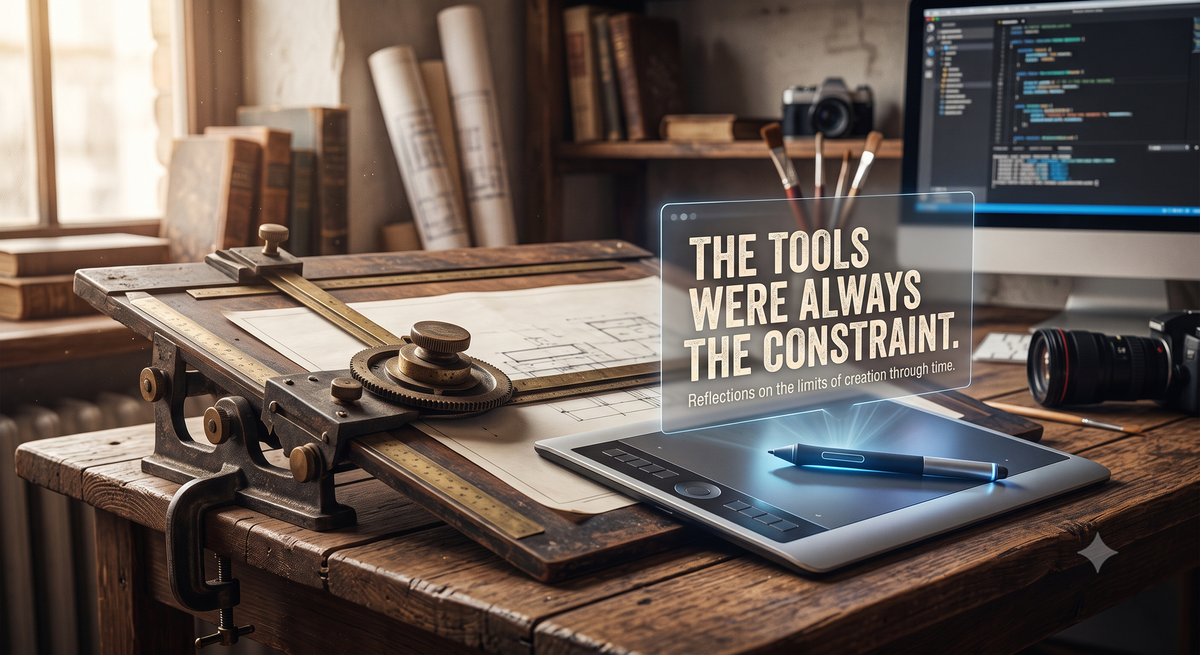
The Tools Were Always The Constraint

The standard theory of competitive advantage went something like this: serious capability requires serious infrastructure.
If you wanted to run a real business, you needed a team. If you wanted to train or run competitive AI models, you needed a server room or a cloud bill that could swallow a small company's monthly payroll. The playing field was not level, but at least the rules were legible. Capital bought compute. Compute bought capability. Capability bought advantage. The people with resources built the things. Everyone else waited.
That logic is breaking apart, and it's breaking fast.
At CES in January 2025, NVIDIA announced Project DIGITS, a personal AI supercomputer roughly the size of a Mac mini. It runs 200-billion-parameter models locally, on your desk, designed for local-first use, with cloud deployment still available when needed, no monthly subscription, and keeping inference on-device for many workflows. Two units networked together can handle models that most production cloud deployments cannot match. Starting price: around $3,000.
Meanwhile, Microsoft and NVIDIA are pushing more inference onto local hardware through NPUs and on-device AI stacks. Neural processing units built into chips, capable of running meaningful models offline. The compute that required a data center until recently now fits in a backpack.
I want to be precise about what is actually happening here, because the framing matters.
This is redefining who gets to build value.
Access was the constraint. That was real. Organizations spent enormous amounts of capital, time, and energy hiring or reskilling, standing up infrastructure, negotiating procurement, and still could not close the gap between what the technology promised and what it actually delivered.
But as access becomes less of a barrier, a different constraint surfaces.
Time.
You could, right now, build an application. Start an edge computing project. Design and fabricate products that were not feasible until recently. Pursue multiple threads at the same time. The tools make all of that genuinely achievable in ways that were not realistic before. The breadth of what is now possible for a single person is almost disorienting.
But breadth and depth are not the same bet.
The person who uses these tools to scatter across every opportunity is building something different from the person who uses them to finally go deeper than they have ever been able to go. One is using leverage. The other is using distraction dressed up as productivity.
The question the tools cannot answer for you is: where do you want to go deep?
And here is where I want to push back on the default framing, because the conversation about AI and tools almost always lands in the same place: entrepreneurship. "The cost of starting is lower. Go build a company."
That is true, and the data backs it. A 2026 Gusto survey found that 50% of respondents said AI made starting a business faster or less expensive.
But starting a company is one possible answer to a much broader question.
The employee who uses local AI tooling to compress a two-week analysis into a half-day does not just become faster. They become the person in the room who can move when everyone else is still scoping. That is a different category of value, and it compounds.
The consultant who can now deliver what used to require a team of three does not just lower overhead. They reposition their entire service. The economics of what they can offer change completely.
The advisor whose decades of institutional knowledge gets amplified by tools that can synthesize, research, and draft at scale becomes something that is genuinely hard to replicate. The pattern recognition that comes from having watched the same failure modes repeat across organizations, industries, and budget cycles was always the differentiator. The tools just removed the friction that used to slow it down.
This is the version of the story that does not get told enough. Not "AI lets anyone start a company," though it does. But that AI lets a domain expert finally operate at the scale their expertise has always deserved.
Think about what that looks like in practice. A plumber with 20 years of field instinct, a 3D printer, AI-assisted design, and an automated quoting system is not just a better plumber. They are building something that operates while they sleep. The expertise was always there. The leverage was not.
The compute is here. The models are here. The access barrier is lower than it has ever been.
So the question is no longer whether you could build something.
The question is whether you want to scatter across everything that is now possible, or use these tools to finally go deeper than you thought you could.
Those are two very different uses of the same leverage.