The Future of Work Is an Authority Design Problem

AI will change work task by task. Whether that produces better jobs, fewer jobs, or more capable organizations depends on decisions that leaders still have to make.
The reassuring line about artificial intelligence is that it replaces tasks, not jobs. A job is not one thing. It is a bundle of research, drafting, coordination, judgment, customer contact, follow-through, and accountability. AI may take on some of that bundle without making the whole role disappear.
But the line is often used to stop the conversation just as it becomes useful.
Replacing tasks is a mechanism. What happens to a job is an economic and organizational outcome. A company can use the same capability to help a worker serve more customers, to redesign a role around better decisions, to consolidate several roles into one, or to maintain the same output with fewer people. The technology does not settle the question on its own.
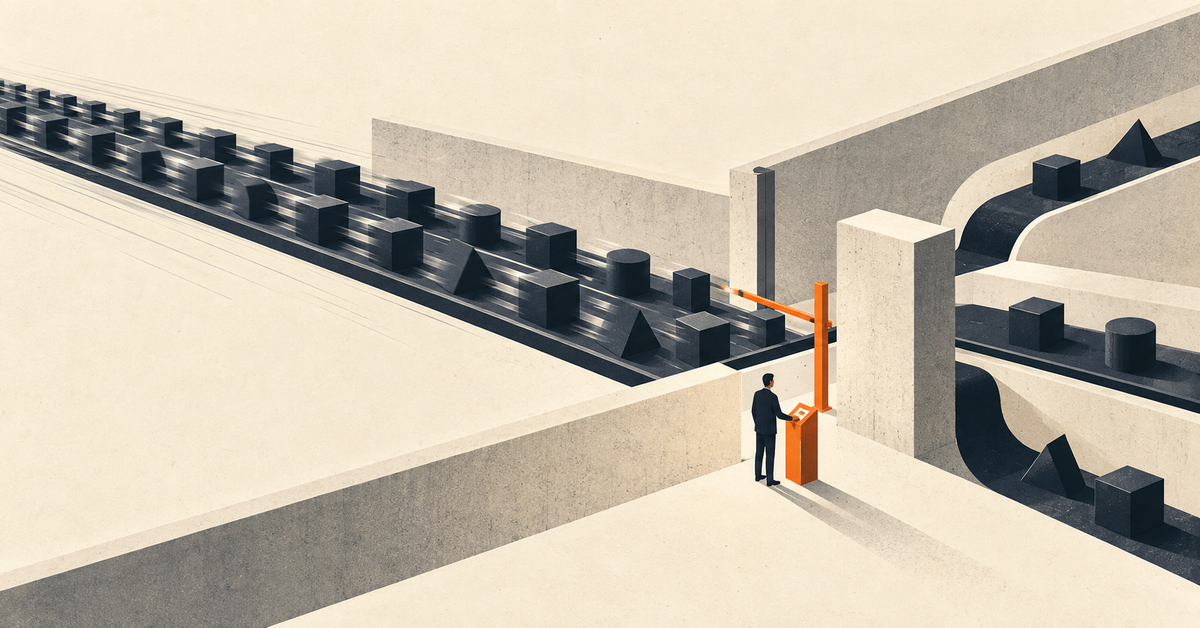
That is why the future of work is not principally a question of which tasks AI can perform. It is a question of authority design: what a system may decide, what it may execute, when it must escalate, who can interrupt it, and who remains accountable for the result.
Productivity does not tell us who benefits
The economic stakes are real, even if the outcome remains uncertain. Economic Scenarios for Transformative AI, a September 2026 working paper from the Anthropic Institute, models three paths from modest to extreme change through 2030. Its scenarios vary the share of cognitive tasks affected, adoption, the productivity gain per task, the balance between automation and augmentation, and the difficulty workers face when moving into new work.
The paper does not claim to predict the future or assign probabilities to its scenarios. In its modest case, AI raises GDP by less than two percent above its no-AI path by 2030 and has little effect on unemployment. In its extreme case, AI performs almost half of today's cognitive work, annual GDP growth reaches 15 percent, the labor share falls from 60 percent to 45 percent, and nearly one in five cognitive workers is unemployed.
The key lesson is that higher output and worse outcomes for some workers can coexist. An economy can become more productive while cognitive workers face lower demand, slower wage growth, difficult transitions, or unemployment. The question is not whether AI creates value. It is how that value is distributed, and whether people can move into the work that remains.
One likely fault line is not simply between people and machines, but between the people who design, own, and direct AI systems and the people who work around their constraints. The first group can capture the leverage of scalable tools; the second may absorb demand volatility through fragmented, low-bargaining-power work. This is not an inevitable outcome of automation. Labor protections, ownership arrangements, education, and social insurance all influence whether productivity gains become broadly shared security or a sharper division of power.
Eric Brynjolfsson makes the complementary point in a recent interview: when AI lowers the cost of a service, employment can either decline or grow. The difference is demand. If lower cost creates much more demand, organizations may need more people, even when each person is more productive. If demand does not expand, the same technology can reduce the number of people required.
“AI replaces tasks, not jobs,” then, is not a promise of job security. It is a description of the first move. Leadership decisions determine what happens next.
The human role is not simply “oversight”
One popular answer is that people will define the problem and evaluate the result while AI does the execution. There is something right in this. As agentic systems become better at producing code, research, analysis, drafts, and routine decisions, the bottleneck often moves from generating an answer to deciding whether the answer addresses the right problem and whether acting on it is safe.
But “the human stays in the loop” is too vague to be useful. It does not tell us whether a person can reverse an action, whether they have enough context to challenge it, whether they are merely approving work at speed, or whether anyone will own the consequences after an automated decision goes wrong.
The durable human contribution is accountable direction. It includes choosing which objectives are legitimate, setting constraints, recognizing when a result is inadequate, and accepting responsibility for the consequences. Those are not ceremonial activities. They are operating responsibilities that need to be designed into the workflow.
This is where the problem of work becomes an authority problem. Every serious AI-enabled process should have explicit answers to five questions:
- What may the system recommend, decide, or execute on its own?
- What evidence must it preserve so that a person can understand and challenge its work?
- Which conditions trigger escalation to a person with real decision rights?
- Who can stop or reverse the system when its behavior no longer fits the situation?
- Who owns the outcome, including harms that emerge after the workflow appears complete?
If a team cannot answer those questions, it has not delegated work responsibly.
Automation can remove the path to judgment
There is a further complication. Judgment is not developed in isolation from execution. Junior analysts learn to identify a bad assumption by doing the research. New engineers learn why an apparently small change can be dangerous by debugging failures. Service professionals learn what a customer actually means by handling the ordinary, repetitive cases before they encounter the exceptional ones.
If AI takes over all of that foundational work, an organization may retain senior experts for a while but lose the apprenticeship path that produces future experts. The result is a strange and fragile arrangement: people are asked to supervise systems without enough direct contact with the work to evaluate them competently.
This does not mean routine work should be preserved for its own sake. It means that organizations which automate it need to deliberately replace its learning function. Give early-career workers structured access to underlying cases, require them to inspect and challenge AI outputs, rotate them through exception handling, and make them accountable for improving the system rather than merely consuming its results. A role redesigned around AI should develop judgment, not simply remove the opportunity to acquire it.
Verification is part of the operating model
Dario Amodei's recent essay, We Must Pace the Frontier, makes the same point at a larger scale. His proposal for embedded external evaluators is not only a policy idea for frontier AI labs. It captures an organizational principle: safety and accountability cannot depend solely on a system owner's description of its own practices.
Independent evaluators need meaningful access to the workflows, tools, permissions, incidents, and evidence that shape a system's behavior. Otherwise, “review” is just a report written from the outside. The proposal is instructive because it turns abstract oversight into a concrete capability: someone with enough access to verify claims, surface inconvenient risks, and publish a second view.
Companies deploying powerful internal agents need their own version of this discipline. The exact form will vary. A finance workflow may require audit trails and approval thresholds. A service operation may need clear handoff rules and customer appeal paths. A software team may need scoped permissions, rollback mechanisms, and independent testing. What they share is a refusal to treat human review as a checkbox.
Design the boundary before optimizing the workflow
The most important question for leaders is not, “How many hours can this save?” It is, “What authority are we giving this system, and what human capability must remain on the other side of that boundary?”
That question is more demanding than a productivity calculation because it includes the quality of the remaining work, the distribution of the gains, the learning path for future experts, and accountability for real-world outcomes. It also produces better implementation questions: Should this system draft or send? Recommend or decide? Operate continuously or only within a defined case? Escalate on uncertainty, on impact, or on a pattern it cannot explain?
AI may make execution abundant. It does not make consequences disappear. The organizations that benefit most will not be the ones that automate fastest in the abstract. They will be the ones that use AI to expand useful output while preserving the human judgment, authority, and learning required to direct it.
The future of work will be shaped task by task. But it will be decided at the boundary between action and accountability.
Sources
- Dario Amodei, We Must Pace the Frontier (September 2026).
- Anton Korinek, Charles I. Jones, Szymon Sacher, Tess Cotter, and Peter McCrory, Economic Scenarios for Transformative AI, Anthropic Institute Working Paper No. 2026-02 (September 2026).
- Eric Brynjolfsson, interview with Silicon Valley Girl, “Stanford's Top AI Economist: The Next 10 Years Will Be the Best AND the Worst in History” (July 21, 2026).