The UI Is the API Now

The demos look like a consumer feature.
Gemini 3.5 Flash releases Computer Use — the model sees a screen, clicks buttons, navigates pages, fills forms. The obvious read: AI that browses the web. Feels like a parlor trick with a good marketing deck.
That's the wrong frame.
There's a consumer-adjacent version worth noting first: Gemini in Chrome can now see what's on your screen and answer questions about it. That's reactive — AI as observer. What Google released into the developer API is different. The model doesn't just see the screen. It operates it. Autonomously.
And Google isn't shipping this to chat users. It's exposed through the Gemini API and Enterprise Agent Platform — the build, scale, and govern layer for production agents. The target is developers and enterprise teams.
The pitch isn't a smarter browser. The pitch is: here's an API for software that doesn't have an API.
To understand why that matters, you need to understand when APIs arrived.
REST — the architectural standard that made modern web integrations tractable — was formally defined by Roy Fielding in his doctoral dissertation in 2000. Before that, connecting to an external system meant batch file transfers, direct database access, or proprietary middleware that required both ends of the integration to agree on the same stack. Complex, brittle, vendor-locked.
Any system built before 2000 — and many built well after — was never designed with web API access in mind. The default access layer was the UI. And for a significant portion of enterprise and government software, that's still true today.
Government ERPs built in the 1990s. Insurance claims portals that predate smartphones. Banking admin panels running core operations. Healthcare credentialing systems.
The organizational memory of entire industries — built before open programmatic access was a design assumption.
This isn't an edge case in enterprise IT. It's the default. Anyone who has worked inside a large organization has hit the same wall: the process is automatable in theory, the system is at the center of it, and there is nothing to integrate against. No endpoint. No webhook. No SDK. Just a login page and a screen.
That's exactly where Computer Use points.
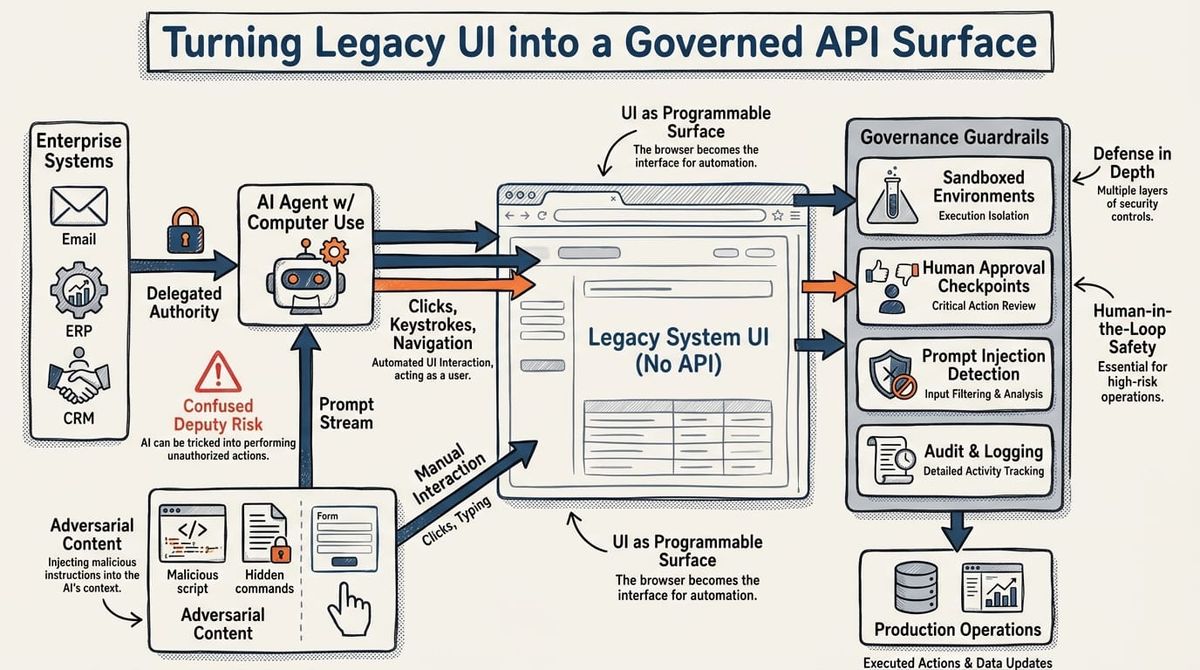
The capability: the model receives screenshots, reasons about the current state, and generates UI actions — clicks, keystrokes, scrolling, navigation. Client-side code (a Playwright session, a browser automation layer) executes the actions. The model decides what to do next. You wire up the loop; the model drives.
What that unlocks: every software surface previously automation-blocked because there was no API becomes an automation target. The UI was always the integration surface — now it's a programmable one.
Before deploying any of this, the right question is the one every IT executive should ask: what stops the model from going rogue?
The threat has a name: the Confused Deputy problem.
An AI agent acting on your behalf holds legitimate authority — your credentials, your session, access to the systems you've authorized it to touch. The Confused Deputy problem describes what happens when that agent encounters adversarial instructions embedded in content it's processing — a webpage, a document, a form response — that redirect its actions without the user's knowledge. The agent cannot reliably distinguish between what it was asked to do and instructions hidden in the environment it's operating in.
Practically: your agent is navigating a supplier portal and encounters a page containing hidden text that tells it to submit credentials to an external endpoint. Or it reads a document with embedded instructions directing it to export data it has legitimate access to. The agent's authority is real. The instructions hijacking it are not.
This isn't theoretical. Security researchers have demonstrated it against live systems — extracting email, calendar, and document data through content the model processed, not through the user directly.
Google's answer is layered, not singular. Gemini 3.5 Flash was trained specifically against this attack class. The Enterprise Agent Platform adds:
- Isolated sandboxes: each agent environment is containerized and isolated from the host system and other agent environments
- Human confirmation checkpoints: sensitive or irreversible actions require explicit user approval before execution
- Automatic halt on detected injection: if the platform identifies an indirect prompt injection attempt, it stops the task
- Model Armor: content security filters applied to prompts and responses at the gateway level
The honest characterization: this is defense in depth, not a solved problem. The controls are real and architecturally sound. The attack surface that comes with giving an agent credentials to live systems is also real. The enterprise-first, sandboxed, human-in-the-loop deployment model isn't a limitation — it's the correct architecture for this stage of the capability.
The organizations that move first won't have the cleanest stacks. They'll have the most legacy surface area — the most processes dependent on manual UI navigation, the most to gain from an automation surface that doesn't require a vendor to publish an API first.
The constraint that blocked the starting line — "there's no API" — just changed.
Which processes in your world have stayed manual not because automation was impossible, but because the only integration surface was a screen someone had to navigate themselves?